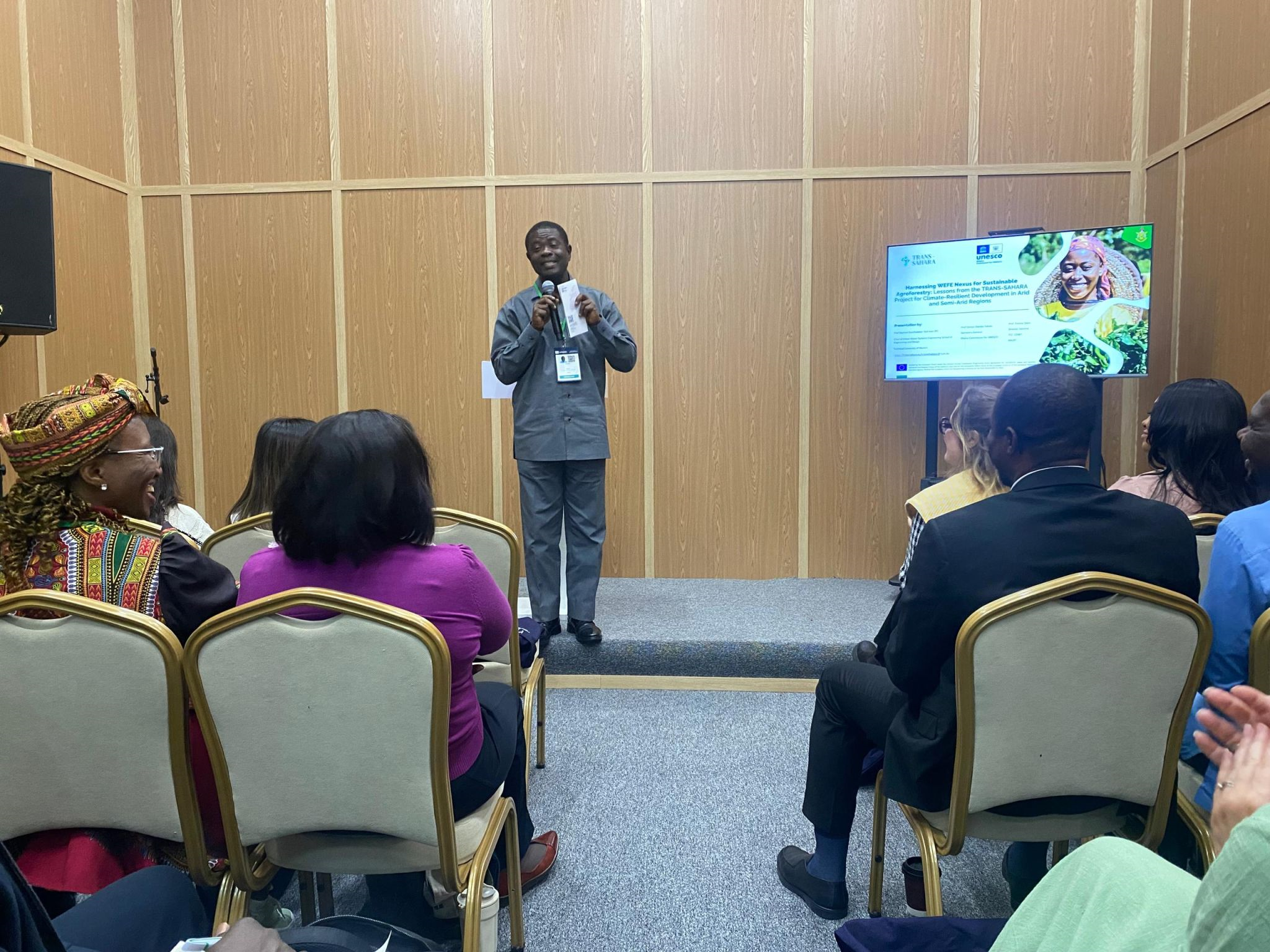
On 7 November 2025, Ghana took center stage at the 43rd UNESCO General Conference in Paris, presenting its leadership in climate resilience and sustainable development. The Ghana Commission for UNESCO, in collaboration with KNUST’s TCC-CIMET (International Centre for Innovation, Manufacturing, Technology Transfer and Entrepreneurship), proudly highlighted the country’s progress under the TRANS-SAHARA Project at the National Commission’s Corner.
Driving climate resilience through innovation
This platform showcased Ghana’s pioneering efforts to tackle water scarcity, land degradation and energy access challenges within the broader African context. Key interventions presented included rainwater harvesting for water security during dry spells, managed aquifer recharge to replenish groundwater, decentralized solar PV systems for clean energy access, grassland regeneration to combat land degradation, biomass planting for sustainable land use, and organic fertiliser application to boost soil fertility and food production.
Harnessing the WEFE Nexus
Our coordinator, Prof. Daphne Gondhalekar (Technical University of Munich), joined Prof. Francis Davis (Director General, TCC-CIMET, KNUST) and Prof. Alexander B. Marful (Director of Business Development and Sustainability, TCC-CIMET) to deliver an insightful presentation titled:
“Harnessing WEFE Nexus for Sustainable Agroforestry: Lessons from the TRANS-SAHARA Project for Climate Resilient Development in Arid and Semi-Arid Regions.”
Their contribution emphasized how integrated approaches—linking water, energy, food and ecosystems—can drive transformative change and reinforce Africa’s resilience through innovation and collaboration.