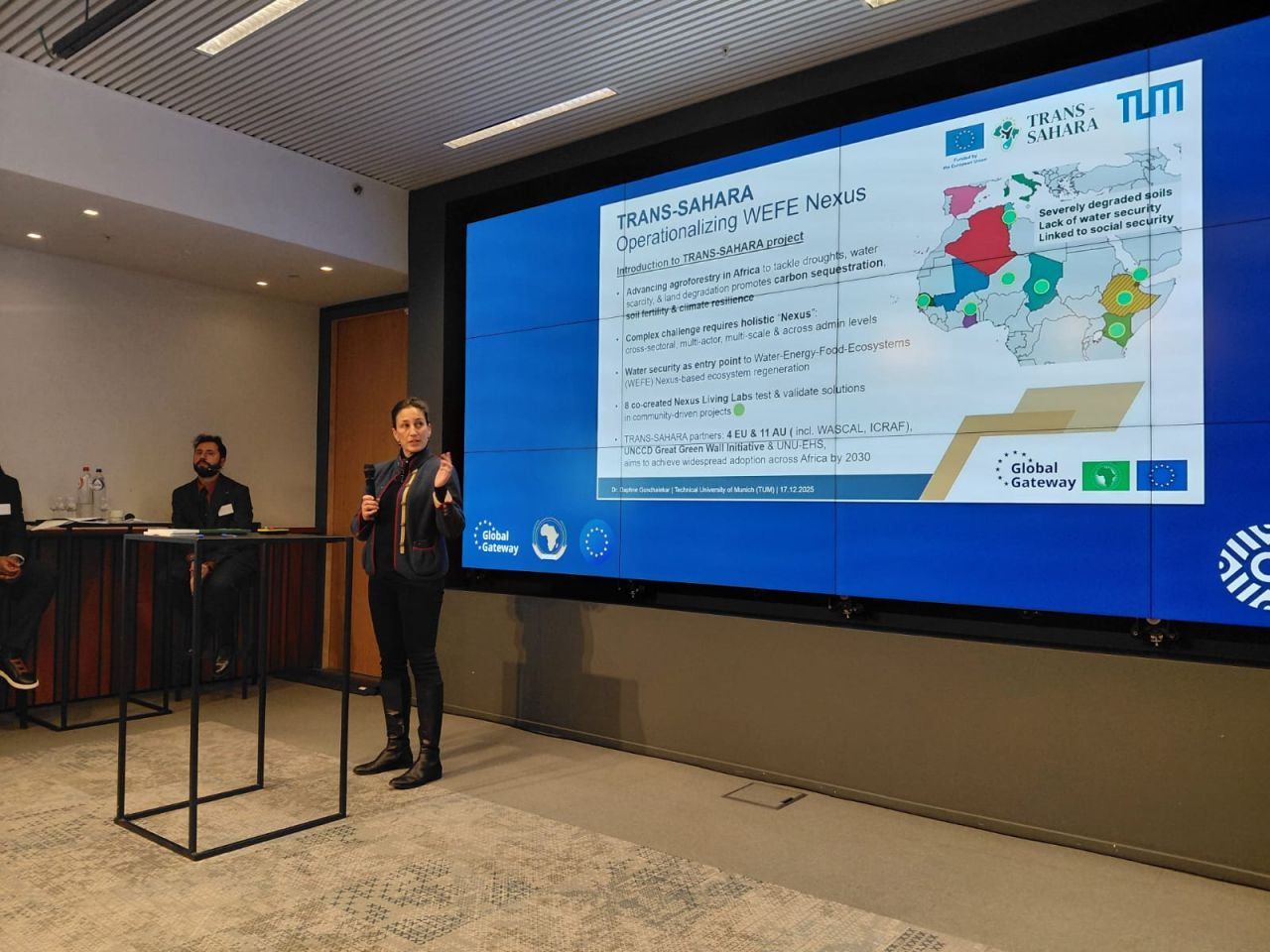
Yesterday, TRANS-SAHARA proudly took part in the 5th Workshop on the Implementation of the AU–EU Innovation Agenda (2023–2033), jointly organised by the African Union, the European Commission, and the Africa-Europe Foundation.
The workshop focused on “Innovations for Climate Resilience & Sustainable Energy in Africa–Europe Collaborations”, aiming to strengthen partnerships and accelerate action on climate adaptation and clean-energy transitions. Discussions explored how social, nature-based and technological innovations can deliver practical solutions, fully aligned with the Green Transition priority of the AU–EU Innovation Agenda.
By convening policymakers, researchers, entrepreneurs and investors, the event provided a space to share knowledge, showcase initiatives and identify opportunities for collaboration that can drive systemic change. Institutional representatives opened with strategic insights, followed by an update on the progress of the 2033 AU–EU Innovation Agenda, which sets the framework for joint research and innovation efforts until 2033.
TRANS-SAHARA’s contribution
Representing TRANS-SAHARA, Dr. Daphne Gondhalekar spoke during the Training & Capacity Enhancement Transformation Scheme session. Her presentation highlighted how the Water–Energy–Food–Ecosystems (WEFE) Nexus can be operationalised through participatory, community-driven approaches and cross-sectoral coordination. These strategies are essential to strengthen institutional capacity, foster policy coherence and enable scalable, climate-resilient solutions.
Dr. Gondhalekar also joined the Innovations for Climate Adaptation Networking Café, engaging with peers on practical implementation pathways and new collaboration opportunities within the AU–EU innovation ecosystem.
Key insights from TRANS-SAHARA
Three priorities emerged from our contribution: building institutional capacity to apply the Nexus approach, integrating policies to overcome sectoral silos, and developing climate finance aligned with Nexus-based solutions. These discussions reinforced the need for holistic planning, nature-based strategies and innovative financing mechanisms to tackle drought, water scarcity and land degradation while advancing the Africa–Europe Green Transition.
The workshop reaffirmed a shared commitment to turning the AU–EU Innovation Agenda into concrete action. TRANS-SAHARA will continue to promote collaborative approaches that link climate resilience, sustainable energy and food security through innovation and capacity building.