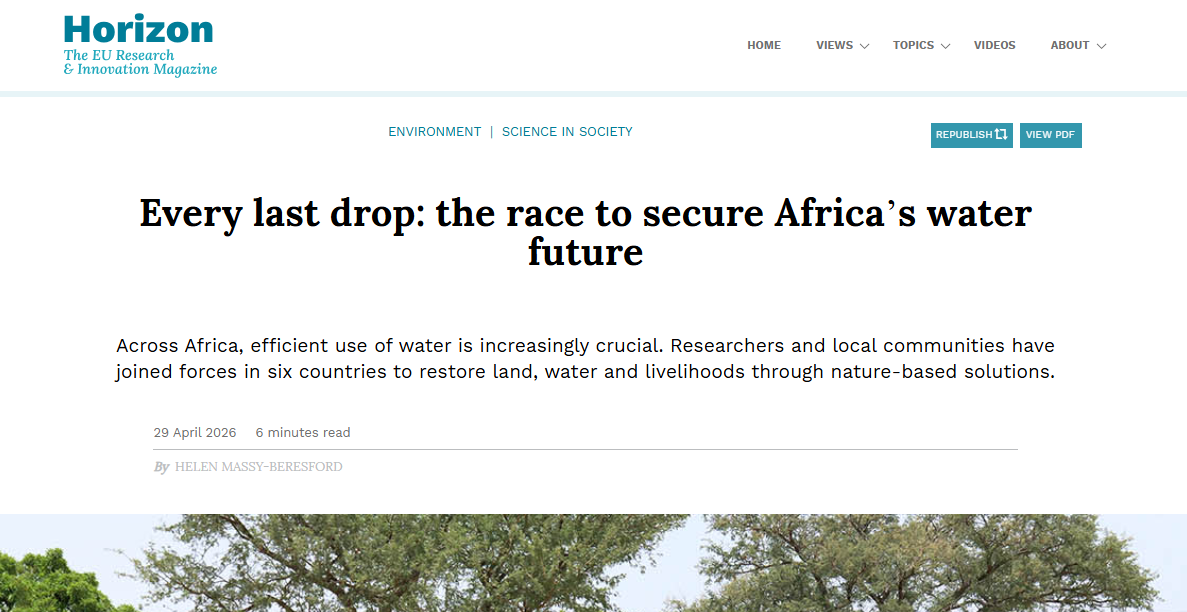
TRANS-SAHARA has been featured in Horizon Magazine, the European Commission’s flagship publication covering innovative research and science funded under the EU’s Horizon Programme.
The article, titled “Every last drop: the race to secure Africa’s water future” by journalist Helen Massy-Beresford, features interviews with our project coordinator Dr. Daphne Gondhalekar and work package leader, Aminata Diallo Sy and highlights how TRANS-SAHARA is working alongside local communities across Africa to restore degraded landscapes, strengthen water security, and develop long-term climate resilience through nature-based solutions. The article places TRANS-SAHARA among leading EU-funded research initiatives addressing some of the world’s most urgent environmental and societal challenges.
The article focuses primarily on our Living Labs and examines how the sites serve as collaborative spaces where researchers, policymakers, and local communities work together to test and implement sustainable land and water management strategies adapted to regional conditions. Particular focus is paid to the lab in Ranerou, Senegal, where local communities and environmental experts are restoring a pond system to improve rainwater retention, strengthen biodiversity, and support agricultural livelihoods ahead of increasingly unpredictable rainy seasons.

As highlighted in the article, the work of TRANS-SAHARA is grounded in listening to communities and integrating local knowledge into scientific practice. Aminata Diallo Sy, Head of Partnerships and Fundraising at the Senegalese Agency for Reforestation and the Great Green Wall, emphasised the importance of community participation in achieving sustainable impact:
“We need the vision of the local communities, because they are the ones who implement the project. They need to be involved to have an efficient project with good results.”
Furthermore, another highlight of the article is TRANS-SAHARA’s use of the Water-Energy-Food-Ecosystems (WEFE) Nexus approach. Wherein, rather than addressing water, food, energy, and ecosystems separately, the project treats them as interconnected systems requiring integrated solutions. Indeed, the feature showcases several innovative approaches being explored across the Living Labs, such as agroforestry techniques, restoration of degraded soils and biodiversity protection.
Massy-Beresford also highlights the project’s emphasis on groundwater recharge which reflects a major shift from conventional extraction-focused approaches. By capturing stormwater during short rainy seasons and redirecting it underground into aquifers, TRANS-SAHARA aims to strengthen long-term water security while reducing pressure on fragile ecosystems.
Dr. Daphne Gondhalekar, project coordinator from the Technical University of Munich, explained the broader vision behind the initiative:
“We use water security as an entry point to explore a broader, more holistic Nexus-based approach to sustainability.”
The Horizon Magazine feature further underlines the growing importance of African-led knowledge and experience in responding to global climate challenges. As Europe increasingly faces droughts, heatwaves, and water stress, lessons emerging from regions such as the Sahel are becoming globally relevant. The article concludes by noting that TRANS-SAHARA’s findings on groundwater management, aquifer recharge, and climate resilience are expected to inform sustainability interventions far beyond Africa.
For TRANS-SAHARA, this recognition represents an important opportunity to amplify the project’s mission and the work being carried out across its Living Labs. It also reinforces the importance of collaborative, community-driven approaches in building sustainable and climate-resilient futures across Africa and beyond.
The full Horizon Magazine article, “Every last drop: the race to secure Africa’s water future,” is available on the Horizon Magazine website.