
On the 5th of June 2026, the TRANS-SAHARA team convened a high-level Science–Policy Dialogue Session in Brussels entitled “Operationalising the Water–Energy–Food–Ecosystems (WEFE) Nexus Approach: The TRANS-SAHARA Project”. The saw participation from representatives of various European, such as the EU Directorate General for Research and Innovation, for Agriculture and Rural Development, as well as African institutions such as the Embassies of Djibouti, Ghana, Tunisia, Kenya and Ethiopia, to explore how integrated WEFE Nexus approaches can be more effectively embedded within policy frameworks and translated into practical action. The session formed part of TRANS-SAHARA’s ongoing efforts to bridge the gap between research, innovation, and policymaking, while ensuring that lessons emerging from the project’s Living Labs can contribute to future African and European sustainability agendas.
Following words of introduction from our coordinator, Daphne Gondhalekar, the group were treated to three presentations from representatives of the European Commission Directorate General for Research and Innovation. The first presentation was delivered by Vincenzo Lorusso, Policy Officer for Science, Technology and Innovation cooperation with Africa. He provided an overview of the African Union–European Union Innovation Agenda 2023–2033 and highlighted opportunities for projects such as TRANS-SAHARA to contribute to broader Africa-Europe cooperation on climate resilience, sustainable agriculture, and innovation. In particular, he presented the Food and Nutrition Security and Sustainable Agriculture (FNSSA) and Climate Change and Sustainable Energy (CCSE) priority areas, as well as the role of innovation partnerships in scaling successful project outcomes beyond pilot regions. We were encouraged to explore opportunities within the AU–EU Innovation Agenda Dashboard and related science diplomacy initiatives to increase the visibility and policy uptake of project results.

Alessandro Calabro’ Desk Officer for Mediterranean and Middle East at the DG for Research and Innovation followed, and presented a range of initiatives coordinated through the Union for the Mediterranean (UfM), including the Pact for the Mediterranean, Mediterranean Initiative III, the Euro-Mediterranean Hub for Research and Innovation, and emerging opportunities under the Horizon Europe 2026–2027 Work Programme. A very fruitful discussion followed, focused on how TRANS-SAHARA’s work on climate resilience, agroforestry, and integrated resource management could contribute to future Mediterranean policy priorities and support regional innovation ecosystems.

Hans-Jörg Lutzeyer, Active Senior Officer at the DG for Research and Innovation, followed on from Alessandro and provided insights into the FNSSA Partnership, the Food 2030 framework, and the ongoing development of the next FNSSA Roadmap (2027–2036). We explored how agroforestry, climate-smart agriculture, biodiversity enhancement, and integrated resource management can contribute to future food systems strategies across Africa and Europe. The discussion highlighted the growing importance of co-benefits, including improved nutrition, climate resilience, circularity, and innovation, as key entry points for embedding Nexus thinking into future policy frameworks.
After these presentations, Daphne Gondhalekar delivered an introduction to the TRANS-SAHARA Project. She introduced the 14 partners and other associated partners, stressing that most of our project’s partners are based in Africa, and she explained the structure of our work packages and the work that each group does.
Following a quick break, we held discussions amongst the entire group, moderated by Stanislav Shmelev, director of the Environment Europe Foundation, another of TRANS-SAHARA’s partners. One of the central discussions of the session focused on understanding why the Nexus approach is strongly reflected in some policy areas while remaining largely absent in others. The group identified several key challenges to this, including the influence of sectoral silos, competing stakeholder interests, and the difficulty of communicating the multiple co-benefits generated by integrated approaches. It was noted that policymakers often respond more readily to clearly quantified economic benefits, creating a need for stronger evidence on the costs and benefits of Nexus-based interventions. The importance of transparency in modelling methodologies, the integration of local and indigenous knowledge, and the need to better communicate trade-offs and synergies were repeatedly emphasised throughout the discussion.

Another recurring theme throughout the session was the importance of ensuring that evidence generated through Living Labs informs future policy processes. Participants stressed that Living Labs can serve as powerful demonstration sites, showcasing how integrated solutions can be implemented in practice while generating evidence for decision-makers. The importance of linking local experiences and community knowledge to regional and international policy frameworks was highlighted as a key mechanism for increasing the impact of TRANS-SAHARA’s work.
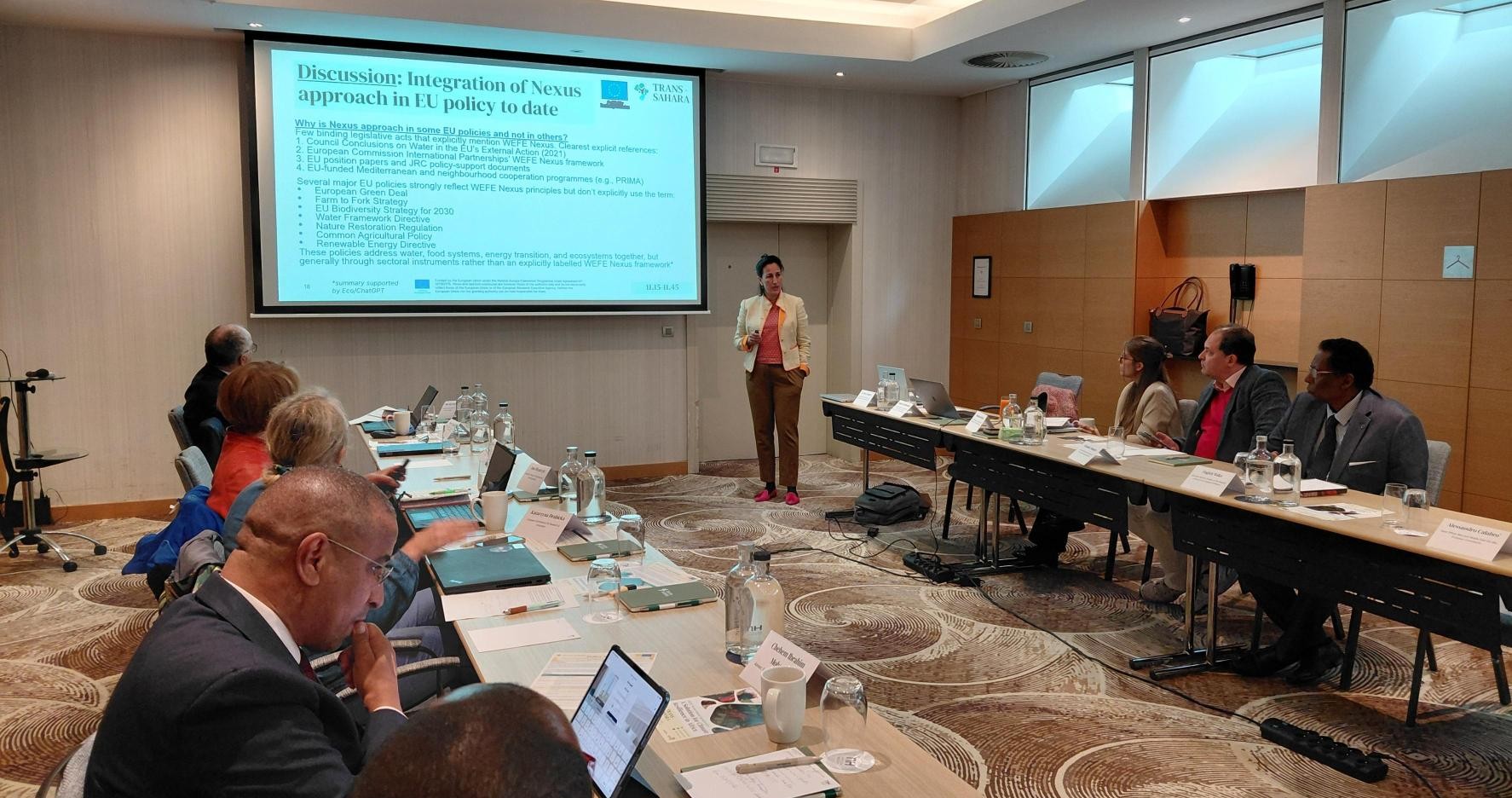
Several speakers also called for greater recognition of local knowledge systems, citing examples from Ethiopia and other African countries where community-led initiatives have successfully supported landscape restoration and climate adaptation efforts.
The session also identified several opportunities for strengthening future policy engagement. Participants discussed the potential of green and resilience financing instruments, the integration of health considerations within Nexus approaches, and opportunities to contribute evidence and recommendations to future Horizon Europe programmes. The representatives from African embassies such as Ghana and Kenya expressed interest in remaining informed about future discussions and project developments, opening potential avenues for deeper engagement with diplomatic stakeholders. The importance of connecting with other initiatives, including Mission Soil, the European Soil Observatory (EUSO), PRIMA, and relevant Horizon Europe projects, was also highlighted. Participants emphasised the need to avoid fragmentation and strengthen collaboration across projects working on similar themes.
As TRANS-SAHARA continues to develop and test integrated WEFE Nexus solutions across its Living Labs, the project remains committed to ensuring that scientific evidence, local knowledge, and stakeholder perspectives contribute to shaping future African and European policies. The discussions held during this first Science–Policy Dialogue have provided valuable insights into how the Nexus approach can move from concept to implementation, helping to build more resilient, sustainable, and inclusive futures across the Greater North African region and beyond.
